AI Search Optimisation
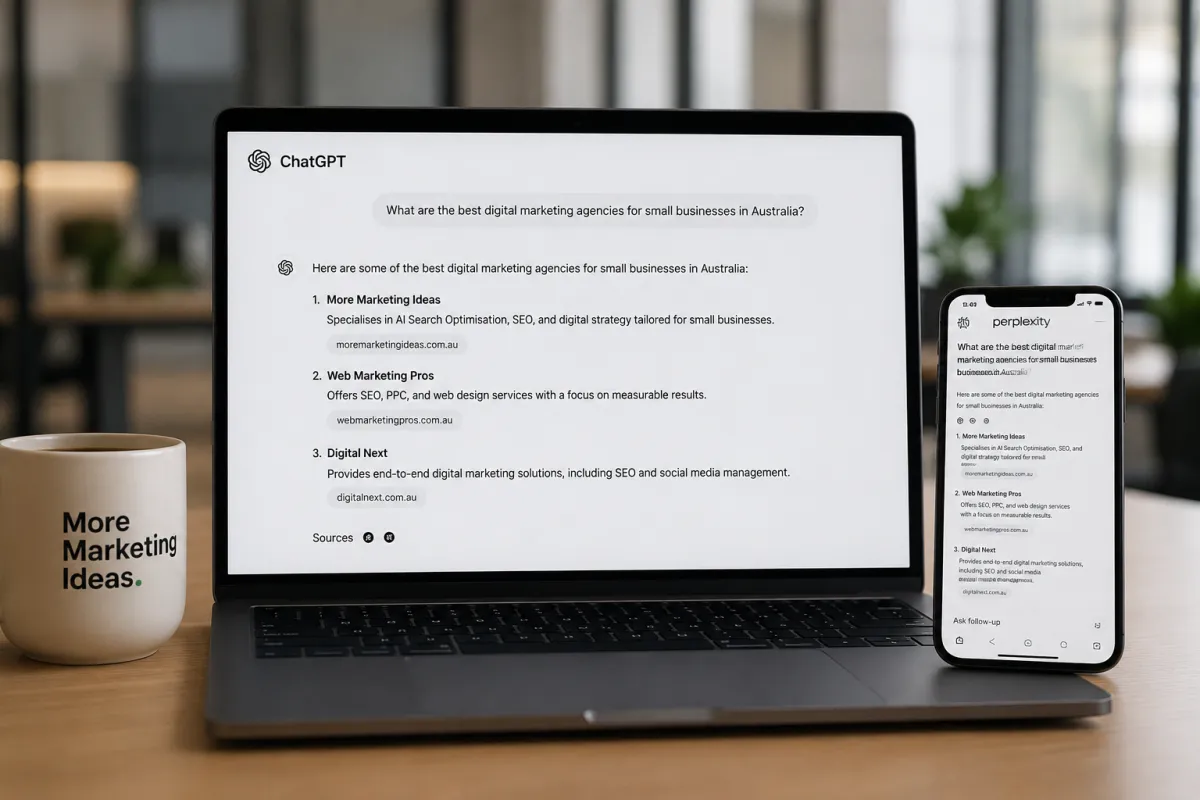
Get your business found and recommended by ChatGPT, Perplexity, and Google AI Overviews.
More customers are asking AI tools for recommendations before they ever open Google. If your business doesn't show up in those answers, you're invisible at the exact moment demand is being formed, no matter how well your website ranks the old-fashioned way.
More Marketing Ideas' AI Search Optimisation service makes sure your business is the one AI tools recommend.
[Book a Free AI Visibility Check →]
What Is AI Search Optimisation?
AI Search Optimisation (also called AEO, Answer Engine Optimisation,
or
GEO, Generative Engine Optimisation)
is the practice of structuring your website and content so that AI systems like ChatGPT, Perplexity, Google AI Overviews, and Claude can find, understand, trust, and recommend your business when someone asks a relevant question.
It's different from traditional SEO.
Traditional SEO competes for a ranked position on a results page.
AI Search Optimisation competes to be the answer itself, the business an AI names directly, with no click required.
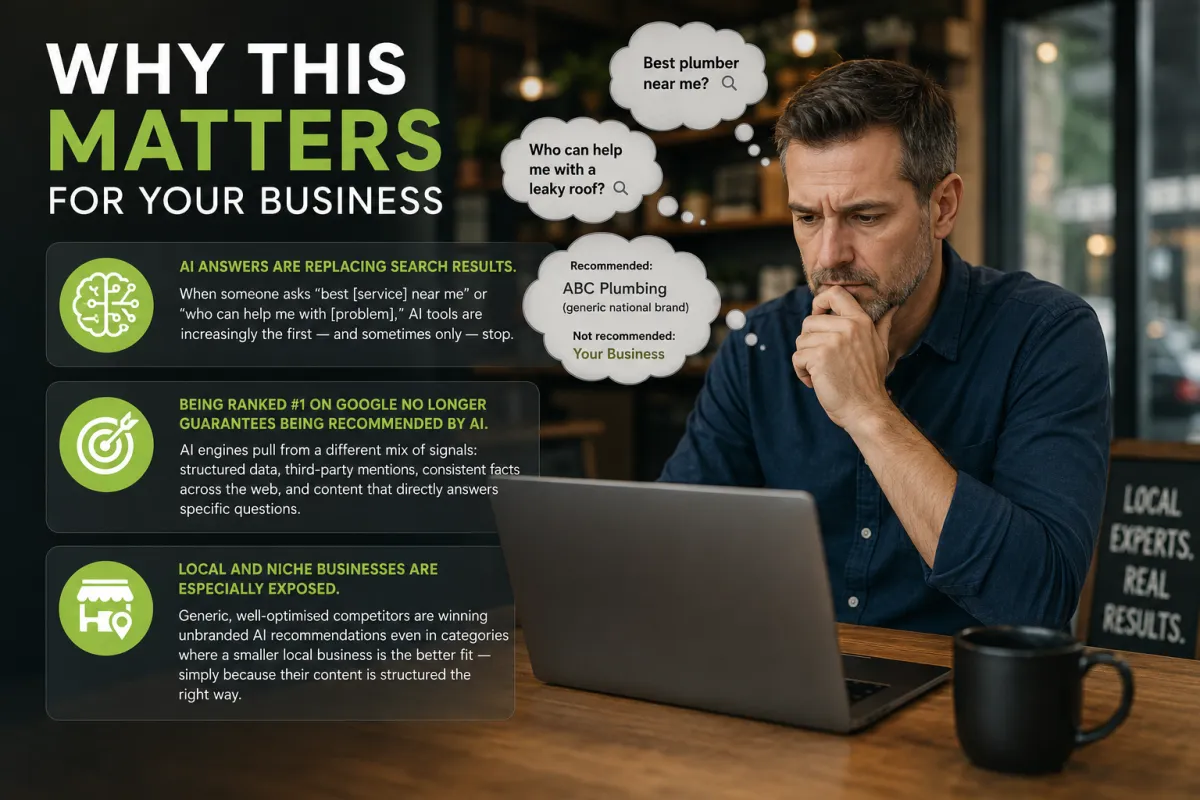
Why This Matters for Your Business
AI answers are replacing search results.
When someone asks "best [service] near me" or "who can help me with [problem]," AI tools are increasingly the first, and sometimes only, stop.
Being ranked #1 on Google no longer guarantees being recommended by AI. AI engines pull from a different mix of signals: structured data, third-party mentions, consistent facts across the web, and content that directly answers specific questions.
Local and niche businesses are especially exposed. Generic, well-optimised competitors are winning unbranded AI recommendations even in categories where a smaller local business is the better fit, simply because their content is structured the right way.
What We Do
Our AI Search Optimisation service audits and rebuilds your online presence around how AI engines actually gather and trust information.
1. AI Visibility Audit
We test how your business currently shows up (or doesn't) across ChatGPT, Perplexity, and Google AI Overviews for the real questions your prospects ask, not just your brand name. You get a clear picture of where you're winning, where you're invisible, and why.
2. Trust & Consistency Cleanup
AI engines cross-check facts before citing a source. We identify and fix conflicting information across your website, directories, and profiles, inconsistent stats, fragmented branding, generic or unverifiable testimonials, that quietly erode AI trust.
3. Answer-Ready Content
We write and structure content in the format AI engines pull from most: direct, specific answers to the exact questions your prospects type, organised with clear headings, FAQs, and schema markup so machines can parse it as easily as people can.
4. Structured Data Implementation
We add Organization, Service, FAQ, and Review schema markup to your site so AI crawlers can extract accurate details about who you are, what you offer, and why you're credible, without guessing.
5. Third-Party Visibility
Since AI engines lean heavily on independent roundups, comparisons, and directories rather than a brand's own homepage, we identify and pursue the third-party mentions and citations that carry the most weight for your category.
What's the difference between AI Search Optimisation and SEO?
SEO optimises for ranking in a list of search results. AI Search Optimisation optimises for being named directly inside an AI-generated answer, often with no click or ranked list involved at all. The two overlap, solid SEO fundamentals still matter, but AI Search Optimisation adds a layer focused on structured data, factual consistency, and answer-formatted content that traditional SEO doesn't cover.
How do I know if I have an AI visibility problem?
Ask ChatGPT or Perplexity the questions your prospects would ask — not your business name, but the problem you solve (e.g. "best [service] in [area]"). If your business doesn't appear, or a less-qualified competitor is recommended instead, that's the gap. We offer a free AI Visibility Check to show you exactly where you stand.
How long does AI Search Optimisation take to show results?
Structural fixes, consistency cleanup, schema markup, can improve how AI engines read your site within weeks. Building topical authority through content and third-party citations is a longer process, typically showing meaningful movement over 2–4 months, similar to traditional SEO timelines.
Do I need a large content library to get started?
No. Many businesses see their biggest early gains simply from fixing inconsistent information and adding structured data, before a single new page is published. Content expansion compounds the result over time.
Is this only relevant for big brands?
The opposite. Local and niche businesses often have the most to gain, because unbranded AI recommendations are currently being won by whichever competitor has the best-structured content, not necessarily the best business. This is a levelling opportunity for smaller, local operators.
Who This Is For
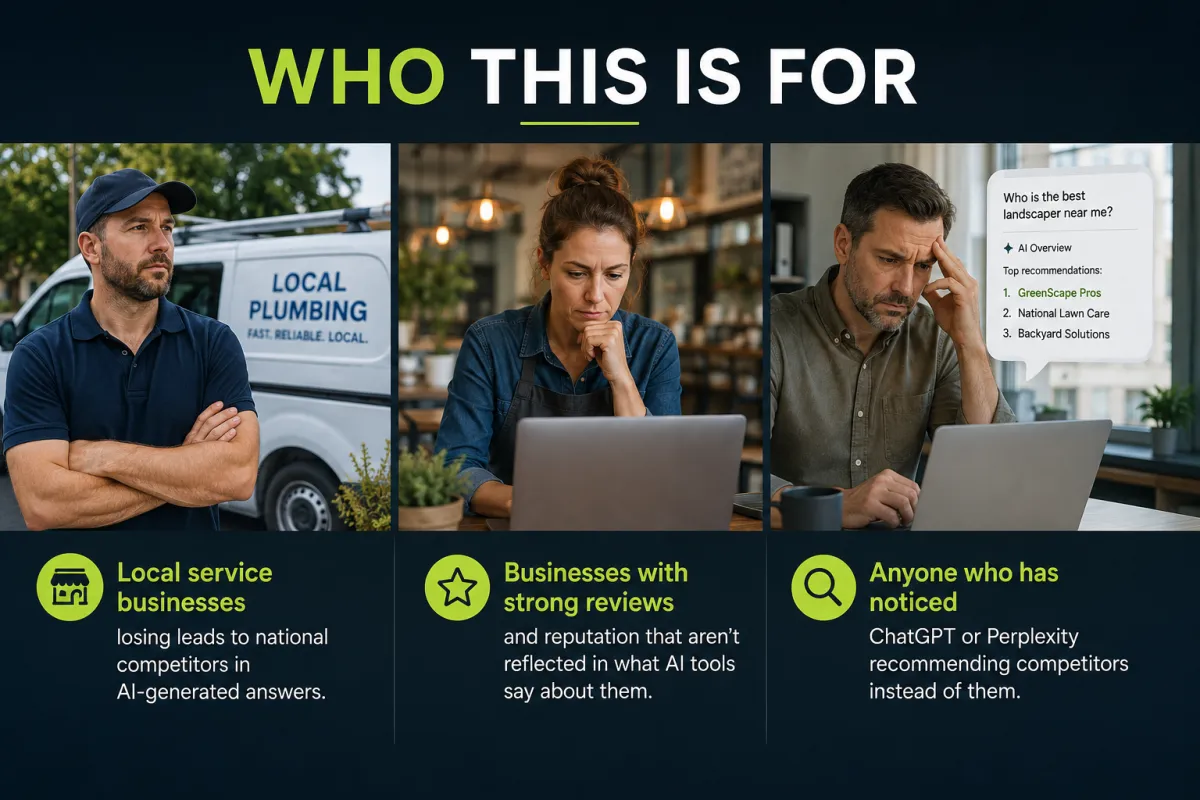
Local service businesses losing leads to national competitors in AI-generated answers
Businesses with strong reviews and reputation that aren't reflected in what AI tools say about them
Anyone who has noticed ChatGPT or Perplexity recommending competitors instead of them